

Voices from the Field: Key Takeaways on Sensible Scaling
At Catalyze, we believe some of the most valuable learning happens when practitioners have the opportunity to learn from one another.
Through our Community of Practice, grantees and the Catalyze team come together to exchange ideas, share lessons learned, and explore challenges facing the field. By centering the experiences and interests of our grantee community, these conversations create space for honest reflections, peer learning, and collective problem-solving.
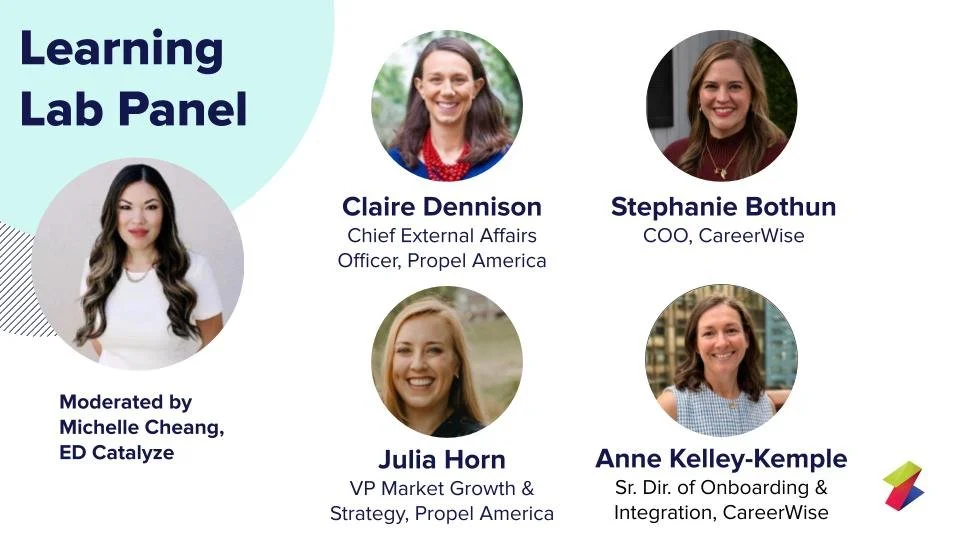
During our May Community of Practice gathering, Catalyze hosted a conversation on sensible scaling, exploring what it takes to grow impact while maintaining quality, strong partnerships, and long-term sustainability. Moderated by our Catalyze Director, Michelle Cheang, the discussion featured voices from two Catalyze Round 4 grantee organizations, CareerWise and Propel America, who shared lessons from their own scaling journeys and offered honest reflections on the opportunities and challenges that come with growth.
Here are a few key takeaways from the conversation.
Scaling Is About More Than Replicating a Program
For Stephanie Bothun, Chief Operating Officer at CareerWise, scaling is not simply about bringing a successful model to a new location. Instead, she challenged participants to think about what she described as ecosystem scaling: the work of helping communities build the conditions necessary for career-connected learning and workforce pathways to thrive.
Rather than focusing solely on program replication, Stephanie emphasized the importance of understanding whether a community has the relationships, infrastructure, and alignment needed to support long-term success. Employer engagement, education partnerships, workforce needs, and local leadership all play a role in determining whether a model can succeed in a new region. Success is a function of aligning programs to community needs and building the right partnerships to address any gaps before launch.
Her reflections underscored a broader lesson for the field: growth is not a one-size-fits-all process. What works in one community may require significant adaptation in another, and organizations must be willing to understand and respond to local context rather than assume a model can simply be transplanted.
Readiness Matters – For Organizations and Partners
Claire Dennison, Chief External Affairs Officer at Propel America, offered a complementary perspective, focusing on the role that readiness and pacing play in successful expansion.
Claire reflected on how growth is often constrained not only by an organization's internal capacity, but also by the readiness of partners within a community. For workforce pathways to succeed, employer partners must be prepared to provide mentorship, create meaningful opportunities, absorb talent, and sustain engagement over time.
As a result, scaling becomes much more than an operational exercise. It requires organizations to carefully assess whether the conditions for success exist before expanding into a new market.
Claire emphasized that growth should not be measured by the number of locations served alone. Instead, organizations must consider whether they can maintain strong alignment between training experiences and actual employment opportunities, a principle that sits at the core of Propel America's work.
‘If There Is No Job at the End, the Work Is Not Complete’
Throughout the discussion, panelists repeatedly returned to the central role of employer partnerships.
For organizations building workforce pathways, expansion depends on more than recruiting participants or launching programs. Success ultimately hinges on whether young people can connect to meaningful employment opportunities.
Panelists discussed the importance of identifying the characteristics of strong employer partnerships and understanding what conditions allow those relationships to flourish. Scaling too quickly can place strain on the relationship-based approaches that often make programs successful. At the same time, scaling too cautiously can mean missing opportunities to serve more young people and meet employer demand.
Continuing the Conversation
Through conversations like this one, the Catalyze Community of Practice continues to create space for grantees to share lessons learned, learn from one another's experiences, and strengthen the field together. We are also grateful to Anne Kelley-Kemple from CareerWise and Julia Horn from Propel America for sharing their insights alongside Claire and Stephanie. Thank you to everyone that joined the conversation, helping to advance an important conversation about what thoughtful, sustainable growth can look like in practice.