Why We Changed the Way We Fund Good Ideas After Five Years
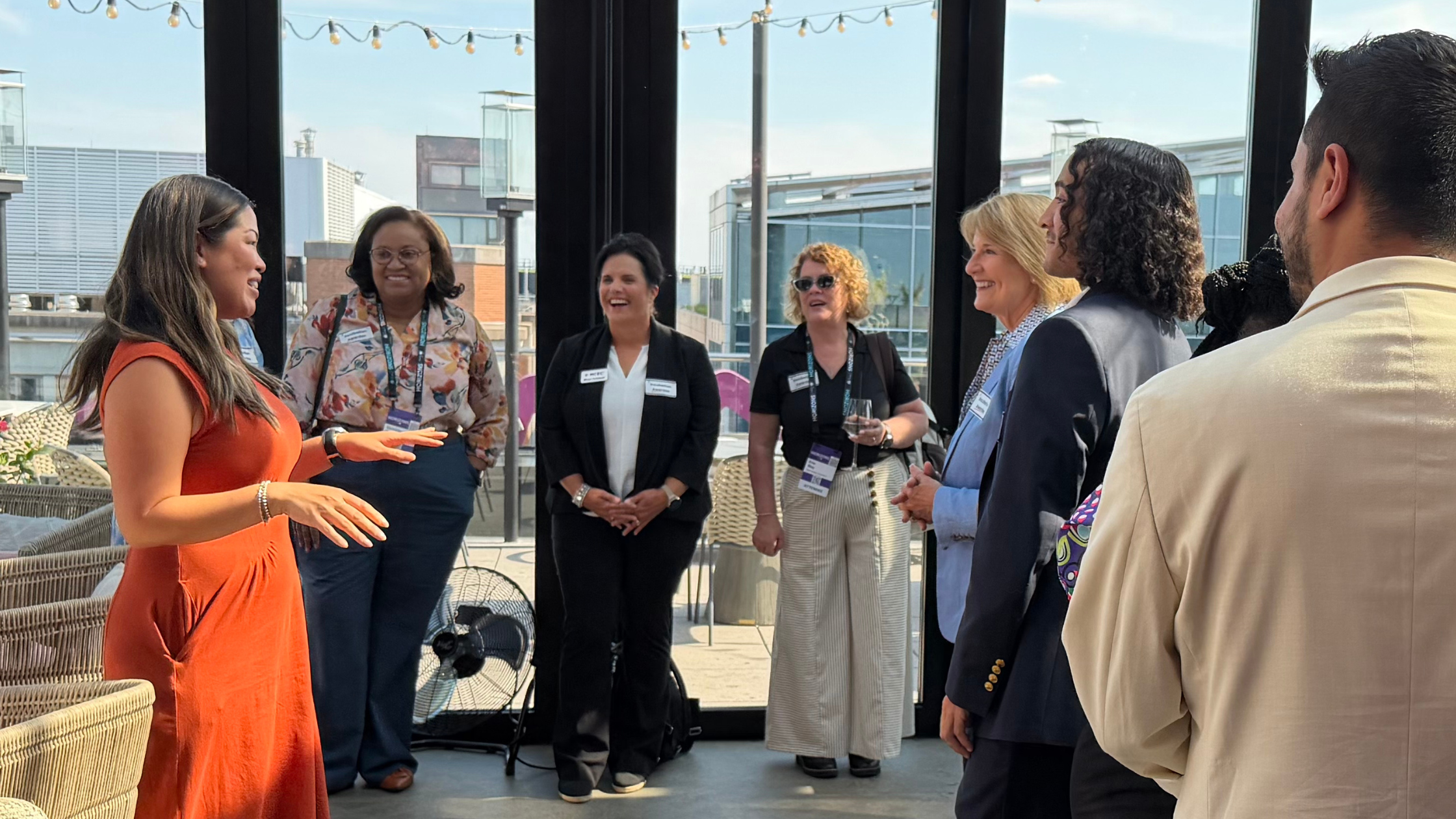
Dr. Michelle Cheang speaking during a Catalyze event in Washington, DC with the Catalyze Challenge Round 5 Phase 2 Incubation Grantees.
For more than a decade before joining Catalyze, I worked on the other side of the grantmaking relationship, first launching youth programs as a nonprofit practitioner, then expanding career pathways as a community college dean. In both roles, I understood what it was like to wait and wonder whether a grant application really captured and conveyed to the funder what my team was trying to build.
That experience has shaped how I think about grantmaking ever since. This month, 14 organizations advanced into the Implementation Phase of the Catalyze Challenge Round 5, and getting to know them along the way has been equal parts exciting and inspiring. It's a reminder that what a young person eventually experiences in one of these programs often takes the collective effort of so many people as they incubate the idea into action.
Since 2021, Catalyze has awarded more than $22 million through national and regional challenges and built a learning community of practice that now includes more than 100 organizations across the U.S. Five rounds in, and the process behind those numbers looks different than it did in Round 1.
I want to share how our grantmaking process has evolved, and why, because none of us can do this work effectively alone. If sharing what we've learned helps another funder, practitioner, or organization move a little faster or more effectively, that's our mission at work.
Learning Over Time
In earlier rounds, we followed a traditional application process. An organization submitted an application making its best case for funding, Catalyze reviewed it, and a decision came back, sometimes with a follow-up call if something needed clarifying.
It worked well enough to fund strong ideas. But an application form could only say so much. Too often, an application alone couldn't fully capture what an organization envisioned, or how much support it would take to get that idea off the ground.
Grantees felt a similar gap from their side. Funding without time to plan meant figuring things out in real time, with the clock already running.
As a former practitioner, I understand that you can't send money out today and expect results tomorrow. Our grantees told us the same thing. They needed time to intentionally plan and build a runway before their ideas could come to life.
Round 5 answers that gap with three phases instead of one, giving an idea room to grow before it has to prove itself in full.
Phase one opens the door widely. It's a general call for innovative ideas to expand career-connected learning, open to any organization with a promising idea for connecting students to high-demand careers, whether through exploration or employer connections.
Phase two, incubation, is where that idea gets refined. Thirty-one organizations received $10,000 and three months of hands-on technical assistance to turn a promising concept into a workable plan.
Phase three, implementation, is where the strongest of those plans get deeper investment, up to $300,000 and a full year of coaching and mentorship to bring the work to life.
Incubation in Practice
During incubation, grantees met regularly with the Catalyze team and as a cohort to refine and workshop an idea before it is submitted for full consideration. That time allows organizations room to ask questions, convene partners, and pivot if needed, so what eventually gets submitted for implementation funding actually reflects what learners and partners need.
At Nurses Middle College, the incubation phase meant working through the details that make a program run effectively, like improving website navigation for learners and making sure families, healthcare partners, and employers could quickly understand what the program offers.
"I initially looked at it like now we have to do more homework," said Andrea Poytner, executive director of Nurses Middle College. "But then the homework actually made a difference because all of it was used to build what we submitted for the grant application."
That same runway gave other organizations room to build relationships they couldn't have built alone.
Dr. Katherine Booher of Accelerate Montana had already lined up some employer partners before Catalyze came into the picture, but Catalyze’s incubation investment brought new ones into the fold.
"By being able to say that we already have this investment [from a national funder], I've been able to approach even more employers and partners who may have otherwise been skeptical or needed some encouragement," Booher said.
New Voices in the Room
Round 5 also marked the first time Catalyze added learners to the review panel alongside national practitioners, partners, and employers. An idea might sound great to us, but if it doesn't resonate with the students it's meant for, something is missing. Having learners review proposals tests that directly.
We welcomed six learners to the Round 5 review panel, recruited through our community of practice and grantee network. The learners are based across the country, from Philadelphia to Birmingham to southern California, and ranged from current high schoolers to college students to at least one already working in the field.
They sat on review teams alongside practitioners, employers, direct service providers, and funders, and their scores received equal weight in the review process. Most had previously participated in a Catalyze-funded program themselves, bringing firsthand experience with career-connected learning.
One of them, Néstor Deras, started their career as a youth apprentice through CareerWise, a Catalyze grantee, and now works there as a manager of operations and compliance.
"I want student perspectives to shape which career‑connected learning ideas get funded," Néstor said. "I enjoy thinking critically about what will genuinely help young people, and this is a valuable way to use my experience as a student to support innovative programs that can expand opportunities for others."
Throughout the process, learners grounded their feedback in their own experience, asking “Did I need this? Would I be excited if this were offered to me?”
Employer perspective mattered just as much. Round 5 specifically sought early-stage ideas built around meaningful work-based learning through employer partnerships, so we needed reviewers who could spot what would hold up once an idea met an actual workplace.
Dr. Eric Dunker, chief business development and strategy officer of WorkForward at UW Health, was one of those voices. WorkForward is an employer-led intermediary that helps health systems build and scale workforce pipelines, and his insights guided how we reviewed applications.
“No industry solves a workforce shortage by only competing for people who are already qualified,” Eric said. “It has to grow that talent, which is the question I kept coming back to during the review process. Would this idea actually help do that? That's what employers and intermediaries are positioned to ask."
I'm proud of how much wider the table has gotten. Centering learners, and bringing in reviewers from across the education and workforce ecosystem, has made our funding decisions stronger and more representative of what the field needs.
A Cohort That Becomes Community
Once an organization is awarded a Catalyze grant through either our national or regional challenges, they also officially become part of the Catalyze community, wherever their journey with us leads next.
For Round 5, that means incubation grantees who did not move forward to implementation still have access to the same peer network and resource hub that supported them during incubation. That peer network is often the resource that grantees point to most enthusiastically.
“It's exciting to be part of the Catalyze community, even just to be connected to other people who are so oriented to the well-being and the futures of young people,” said Beth Rabbitt, founder of Moxie Public Schools.
Our community of practice exists to keep that connection going beyond funding, a place where organizations learn from each other, swap what's working, and stay in touch with people facing the same challenges elsewhere.
"We want Catalyze to help people [in the field] stop making the same mistakes so they make progress faster,” said Brandy Jackson of Scoutlier, a two-time grantee (Round 1 and Round 5), reflecting on what it meant to sit in a cohort of organizations wrestling with the same hard questions at the same time. “We've got to learn from each other what's working, what's not working, and make growth happen faster.”
That's exactly how I think about this work. In order for us to move the needle, we have to do it as a collective. Our community of practice keeps that work going long after any single round of funding ends, through the connections and conversations organizations keep having with each other.

Members of the Catalyze Community of Practice exchanging ideas and perspectives at an event showcasing the Round 5 Phase 2 Incubation Grantees.
Our Continued Evolution
Our current approach to grantmaking is a direct result of listening to what our grantee community has taught us. That doesn't mean this approach is perfect, or that we will stop iterating.
Pittsburgh is proof that change doesn't stop at the national level. Catalyze's newest regional challenge, a $1.5 million partnership with Partner4Work and the Richard King Mellon Foundation, connects young people ages 11 to 18 across six Southwestern Pennsylvania counties to careers in emerging industries, using the same three-phase approach as Round 5.
Learn more about the Catalyze Challenge and the Catalyze Community of Practice, and sign up for our newsletter to follow along as Round 5 and Catalyze Pittsburgh unfold.